

If you are into pastels, you have probably seen Richard McKinley’s watercolor demonstration on PastelMat. It is an amazing surface, surprisingly smooth and yet able to grab onto and hold layers of (soft) pastel. I have never felt like I needed to use a fixative to “glue” the pastel to the surface. Even though I was intrigued by this surface, it still took me some time to learn how to work with it.
My first work with PastelMat was a series of landscapes. They were OK; not my favorites. I felt that there was something about the surface that made me work with a tighter approach. There is nothing wrong with that. I just like my looser, more abstract paintings better. So now I know that if I want to create something more realistic, this is the go-to surface.
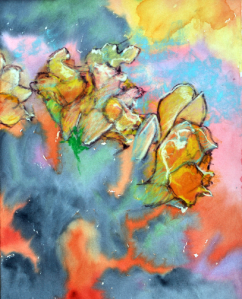
The next thing I tried to do was florals. Again, I don’t usually get too excited about florals but I found that this surface worked very well for them. I felt like I could paint the delicacy, the weight of the petals by leaving some of the underpainting show throw.
It is funny, when I do landscapes, I want to paint people. When I paint people, I want to paint landscapes. I think I discover “something” in the process of working on “this” that will enhance what I what I want to do over “there.” I think we artists are really visual scientists. We try things, and observe. We ask ourselves what went well, and what went wrong. Then we search for those solutions. And start the process all over again. And it is fun!
This was supposed to be a watercolor underpainting for a pastel painting, but it turned into mixed media piece. I used watercolor, graphite, colored pencil (on the lips) and a touch of white pastel.

And now that I have convinced myself that PastelMat is the surface for more realistic work, I want to work with it again to see just how impressionistic I can get. See? It just never ends. One idea leads to another…
Creativity is allowing yourself to make mistakes.
Art is knowing which ones to keep.
~ Scott Adams
 Pastels Rock